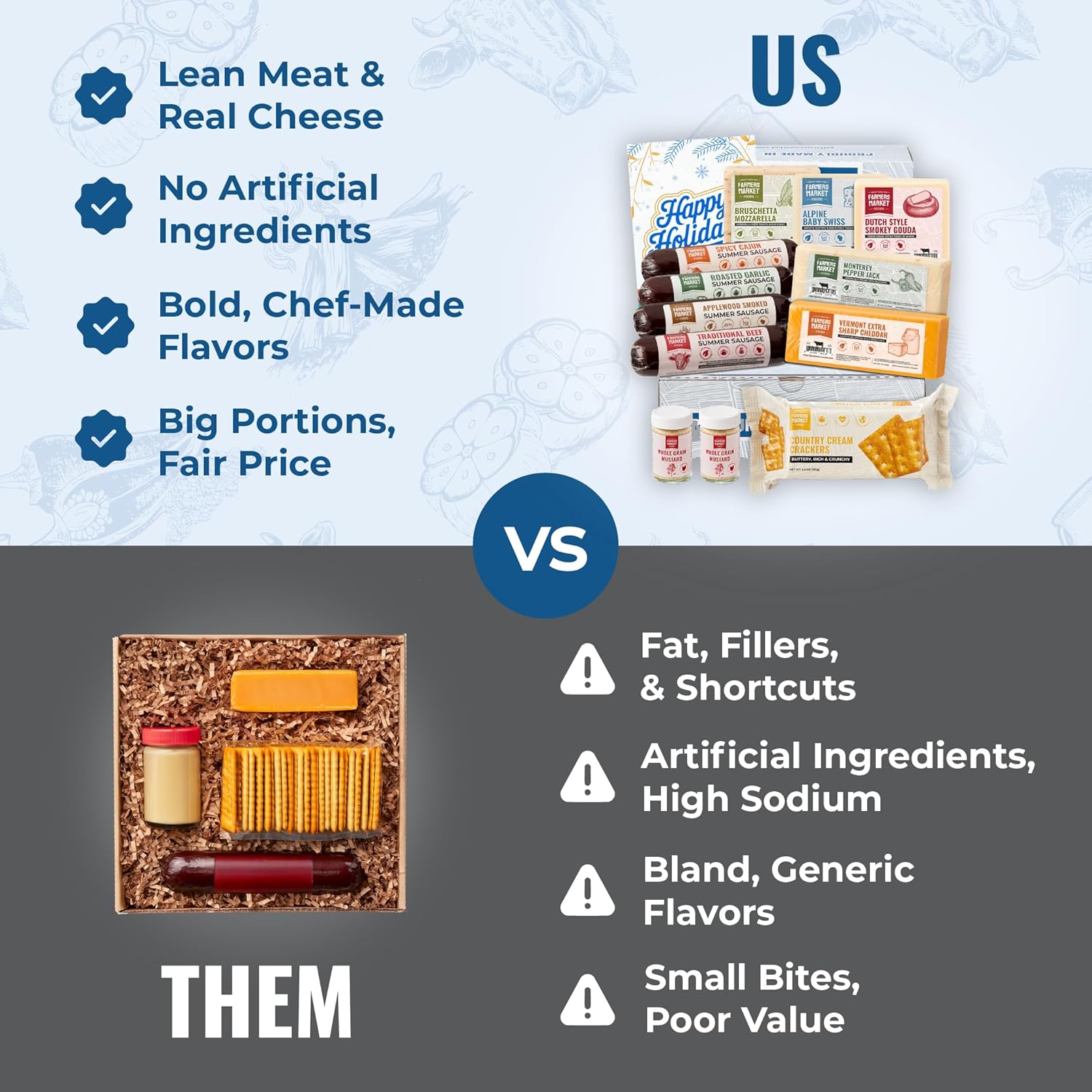
When someone in your life follows a strict diet — whether for religious observance, a metabolic health goal, or a medical necessity like celiac disease — a cheese gift basket can feel like either a perfect gesture or a minefield. Cheese itself is naturally free of gluten (the protein found in wheat, barley, and rye that triggers reactions in people with celiac disease or gluten sensitivity) and is generally low in carbohydrates, which makes it a natural fit for keto eating (a high-fat, very low-carb dietary pattern). Kosher certification — a religious standard that governs not just ingredients but sourcing, processing, and facility supervision — is a different and more complex layer entirely. The problem isn’t the cheese. It’s everything else in the basket: the crackers, the cured meats, the glazed nuts, the flavored mustards, the decorative breadsticks that look lovely and contaminate everything around them. This guide breaks down what dietary labels on gift baskets actually mean, where the most common gaps are, and how to match the right basket to the right recipient without calling the recipient to ask awkward questions about their diet.
| EDITOR'S PICKFarmers Market Meat & Cheese Gi… | Mid-tier[igourmet Authentic Imported Ita…](https://www.amazon.com/dp/B0000TVVEA?tag=greenflower20-20) | Budget pick[Farmers Market Wisconsin Cheese…](https://www.amazon.com/dp/B0CRM55TF8?tag=greenflower20-20) | |
|---|---|---|---|
| Dietary labels | Keto friendly | — | Gluten free, Keto friendly |
| Cheese origin | Wisconsin | Imported Italian | Wisconsin |
| Includes meat | ✓ | — | ✗ |
| Item count | — | — | 6 Count |
| Weight | — | 22.5 oz | — |
| Includes crackers | ✓ | — | — |
| Price | $69.99 | $39.98 | $35.99 |
| See on Amazon → | See on Amazon → | See on Amazon → |
What the Labels Actually Mean — and Where They Usually Break Down
Let’s start with the honest version of what “gluten-free,” “keto-friendly,” and “kosher” mean when they appear on a gift basket product page, because the language is frequently imprecise.
Gluten-free on a basket typically means the seller has substituted gluten-free crackers or omitted crackers entirely. What it does not automatically mean: that the facility is free of cross-contact with gluten, that every charcuterie item (many sausages use wheat as a binder or filler) has been verified, or that the flavored cheeses in the collection — smoked varieties, beer-washed rinds, or blends with added seasonings — are safe. The Celiac Disease Foundation’s “Sources of Gluten” reference document is explicit that cross-contact in shared facilities is a distinct concern from ingredient-level gluten, and most basket sellers do not publish facility-level information. For a recipient with celiac disease (as opposed to a preference), this distinction is clinical, not cosmetic.
Keto-friendly is the loosest label of the three. Bon Appétit’s “What Is Keto, Actually?” explainer defines the dietary pattern as targeting under 20–50 grams of net carbohydrates per day, with the majority of calories from fat. Aged cheeses fit beautifully — they’re high fat, negligible carbs. The problem in gift baskets is the accompaniments: dried fruits, honey, fruit pastes (called “membrillo” or quince paste — a traditional pairing with manchego), and artisan jams can contain 15–30 grams of carbs per small serving. A basket marketed as “cheese and charcuterie” with no crackers can still contain a honey dipper and a 4-ounce fig spread that blows the daily carb budget in two bites. “Keto-friendly” on a basket label is almost never independently verified; it’s usually a marketing inference from the presence of cheese.
Kosher is categorically different because it involves a certification body, not a seller’s judgment call. Kosher dietary law (called “kashrut”) prohibits mixing dairy and meat, requires that animals be slaughtered according to specific religious requirements, and mandates supervision of production by a certified authority. The Orthodox Union’s consumer guide “Kosher Certification: What Does It Mean?” explains that the OU symbol (and equivalents like OK, Star-K, or Kof-K) on individual products does not automatically make an assembled basket kosher — if a kosher cheese wheel sits alongside non-kosher charcuterie in the same package, the basket is not kosher. A truly kosher gift basket must be either all-dairy or all-meat/pareve (neutral), assembled in a kosher-certified facility or under rabbinical supervision, and sealed with the appropriate certification. Very few mainstream retailers meet this bar.
By the Numbers: Dietary Claim Reliability by Retailer Type
| Retailer category | Gluten-free claim reliability | Kosher certification | Keto label accuracy |
|---|---|---|---|
| Specialty curators (Murray’s, Zingerman’s, Cowgirl Creamery) | Moderate — ask about facility cross-contact | Limited custom builds available on request | Low — accompaniments often include fruit pastes |
| Artisan mid-tier (iGourmet, Mouth.com, Goldbelly) | Moderate to high — several GF-dedicated SKUs | iGourmet carries certified-kosher lines | Mixed — “low carb” framing varies by SKU |
| Mass-market (Harry & David, Hickory Farms) | Low — shared facilities common | Not typically certified | Low — prominent sweet accompaniments |
Assessment based on publicly available product pages, published certifications, and retailer FAQ documentation reviewed as of May 2026.
Gluten-Free Baskets: Where to Focus Your Due Diligence
For a recipient with celiac disease, the safest approach is to treat “gluten-free basket” as a starting point for a conversation, not a finished answer. Here’s the decision tree that actually works:
Step 1: Separate the cheese from the accompaniments. Every major cheese in a premium basket — aged cheddar, manchego, gouda, gruyère, parmesan — is naturally gluten-free. Serious Eats’ feature on affinage (the French term for the professional aging and care of cheese, pronounced “ah-fee-NAHZH”) notes that aging itself introduces no gluten. The risk concentrates in added-flavor cheeses and in everything else in the box.
Step 2: Flag the charcuterie. Many salami and sausage products use wheat as a filler or binder. Prosciutto di Parma and Jamon Iberico, in their pure forms, are gluten-free, but flavored or processed meats are not reliably so. iGourmet publishes product-level ingredient filters on their site; Goldbelly relies on producer-supplied information, which is less standardized.
Step 3: Verify the cracker situation. The most common substitution — rice crackers or almond flour crisps — is widely available. What’s less consistent is whether those alternatives are produced in a dedicated gluten-free facility. For someone with a preference, this is usually fine. For celiac, it’s the question to ask before ordering.
Step 4: Consider a build-your-own approach. Murray’s Cheese custom build program allows component-level selection, which means you can specify gluten-free crackers and flag charcuterie requirements. Zingerman’s hand-packed collections have a similar custom path through their deli team. The trade-off: you’ll pay a service premium, and you need to initiate the conversation explicitly — the gluten-free filtering on their public-facing pages does not automatically produce a celiac-safe result.
Kosher Baskets: The Certification Gap Is Real
If you’re sourcing a kosher basket for a corporate gifting program, this is the section that will save you a difficult conversation. The short version: the vast majority of premium cheese baskets are not kosher, even when they contain cheeses that carry individual kosher certification symbols.
Food & Wine’s “How to Read a Cheese Label” guide explains that kosher cheese requires rennet (the enzyme used to set the curd) from a kosher-certified source, and that the production facility must be under rabbinical supervision. A significant portion of artisan American cheeses — including many celebrated cave-aged varieties from smaller creameries — use animal rennet from non-certified sources or are produced in facilities that also handle non-kosher products.
For a dairy-only basket, iGourmet is the most straightforward option in the artisan mid-tier: they maintain a dedicated kosher product filter with certification marks listed at the product level. For corporate accounts sourcing 25 or more baskets, it’s worth contacting their B2B team directly to confirm that a kosher basket can be assembled to meet your specific requirements, because individual certified components assembled by a non-certified operator in a non-certified environment creates a compliance question that some observant recipients will notice.
The meat-and-cheese mixing problem is the most common and most avoidable error in corporate gifting. A basket that contains both artisan cheese and salami — even if both products carry individual kosher symbols — is not kosher if they are mixed. The dairy-meat separation rule in kashrut is not symbolic; it governs the meal as a unit. The safe play for a mixed-dietary corporate list: send a cheese-only basket and source it from a seller who can document facility-level kosher supervision, or confirm with the recipient before ordering.
Eater’s 2025 roundup of the best cheese mail-order services flagged this gap explicitly: “Kosher-certified cheese baskets remain an underserved category; most sellers use the term loosely.”
Keto Baskets: The Accompaniment Problem
If keto is the concern, the math is simple and worth running before you order.
A standard mid-tier cheese and charcuterie basket from a retailer like Mouth.com or Harry & David will often include: a 4 oz jar of honey (approximately 68g of sugar), a 3.5 oz package of dried apricots or cranberries (approximately 55–70g of sugar), a fruit paste or jam (10–25g of carbs per 2-tablespoon serving), and water crackers or flatbreads. None of that is cheese. None of it is keto-compatible. The cheese and the salami are essentially bystanders in a carbohydrate delivery vehicle.
The if-then decision rule for keto gifting:
- If budget is under $75: Harry & David and Hickory Farms have few keto-optimized options. Your best move is to order a cheese-only selection and skip the curated basket format entirely.
- If budget is $75–$150: Mouth.com and iGourmet have individual SKUs with clean accompaniment profiles — look for baskets that lead with cured meats, aged cheeses, and nut-based accompaniments rather than fruit pastes and sweet jams. Read the full item list, not the marketing headline.
- If budget is $150+: A Murray’s or Zingerman’s custom build lets you swap every non-compliant accompaniment. Specify: “no crackers, no fruit pastes, no honey accompaniments — substitute with additional aged cheese selection and whole-grain or nut-based crackers.” Both programs can accommodate this with advance notice; for orders of 10 or more, their account teams are generally responsive to dietary customization requests.
The Decision Framework: If X, Then Y
Here’s the practical matrix for the most common scenarios:
If the recipient has confirmed celiac disease → Contact the retailer’s customer service before ordering and ask specifically about shared-facility cross-contact. If they cannot answer the question, choose a different retailer. Murray’s custom builds and iGourmet’s dedicated gluten-free filter are your two most reliable starting points.
If the recipient keeps strictly kosher → Do not infer from the presence of kosher-certified cheeses that the basket is kosher. Order a dairy-only basket from a retailer that publishes facility-level kosher supervision, or confirm with the recipient what level of certification they require. Corporate gifting managers: build a “confirmed dietary requirement” field into your intake form for client gifting orders — it’s the single change that eliminates the most uncomfortable follow-up calls.
If the recipient is following keto for metabolic health reasons → The accompaniment list is the basket. Read every item. Reject any basket where more than half the contents by count are high-carb accompaniments. A premium aged cheese selection with salami, olives, and nuts is inherently keto-compatible; the basket format is not.
If you’re unsure of the specific requirement → A curated aged-cheese-only selection — no crackers, no jam, no honey — is the most diet-agnostic gift you can send. It sidesteps gluten, carb, and dairy-meat mixing concerns simultaneously. It’s also, for what it’s worth, the most generous expression of the format: the cheese is always the point.