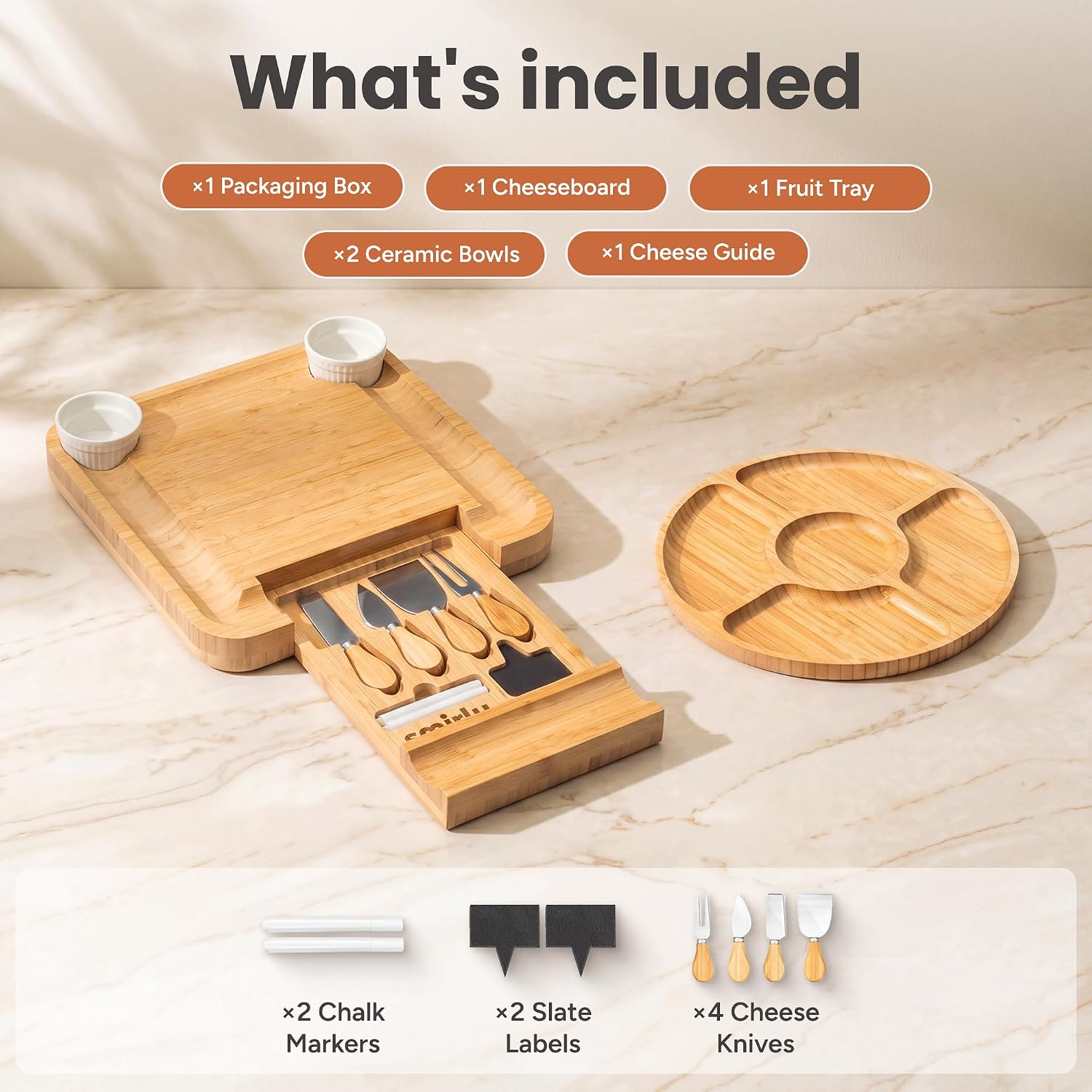
A charcuterie board gift set — a packaged bundle that typically includes a wooden or slate serving board, a small set of knives or spreaders, and sometimes ceramic bowls or ramekins — is one of the most popular upgrades inside a premium cheese and charcuterie basket right now. The appeal is obvious: the recipient gets a complete presentation tool, not just something to eat through and recycle. But “board set” is where product descriptions earn their keep in vagueness. Terms like “acacia wood,” “professional-grade knives,” and “generous serving size” are doing a lot of marketing work with very little information. If you’re sourcing these sets for a corporate gifting program, building a high-end basket assortment, or trying to decide whether a $95 set is meaningfully better than a $45 one — you need a different frame than what the listing gives you.
This guide translates the specs that appear on packaging and product pages into the things that actually determine whether a set earns a second look or ends up at the back of a cabinet. We’ll cover wood species and what they predict about longevity, how to size a board to the occasion and recipient, and what knife specs actually signal about quality versus what they obscure. We’ll also give you a clear decision rule at the end, because the real split in this category isn’t price — it’s use case.
| EDITOR'S PICK[Shanik Upgraded Acacia Cheese B…](https://www.amazon.com/dp/B07GFVK13N?tag=greenflower20-20) | Mid-tier[Bamboo Charcuterie Board Gift S…](https://www.amazon.com/dp/B078X12B3V?tag=greenflower20-20) | Budget pick[Bambüsi Charcuterie Boards - La…](https://www.amazon.com/dp/B01DTFF0Y8?tag=greenflower20-20) | |
|---|---|---|---|
| Material | Acacia | Bamboo | Bamboo |
| Board shape | Square | — | — |
| Hidden drawers | — | ✓ | — |
| Bowls included | — | ✓ | — |
| Price | $89.99 | $69.95 | $39.99 |
| See on Amazon → | See on Amazon → | See on Amazon → |
Wood Species: What “Acacia” and “Bamboo” Are Actually Telling You
The wood a board is made from is the single most consequential spec in the set, and it’s also the one most commonly treated as a style note. Here is what the common options actually mean in practice.
Acacia is the default material at every price tier from $35 to $150. It’s a dense, tight-grained hardwood with natural oils that slow moisture absorption, which makes it reasonably durable under normal serving conditions. The practical downside: acacia is highly variable. It’s not a single species — it’s a genus of over 1,300 trees, and the boards marketed as “acacia” source from multiple producing regions with inconsistent quality control. Wirecutter’s long-run owner report compilation on cheese boards notes that acacia boards at the lower end of the price range show early cracking around the edges within one to two seasons, while boards from producers who specify origin (East African acacia versus Southeast Asian plantation acacia, for example) hold up significantly better. When a product page says “acacia” and nothing else, treat it as a signal of undifferentiated sourcing.
Walnut and maple are the materials that show up when a producer is making a genuine quality argument. Both are American hardwoods with tight, stable grain structures. Walnut is softer than maple, which means knives score it over time — fine for a display and serving board, not ideal if the recipient is a serious home cook who’ll also use it for prep. Maple is harder and more resistant to scoring, which is why it dominates professional kitchen applications. Food & Wine’s charcuterie board roundup notes that end-grain maple boards (where the wood fibers run vertically, facing upward) are the gold standard for longevity but command a price premium that pushes most gift sets past the $120 threshold.
Bamboo is often marketed as premium because of its sustainability credentials and pale, modern aesthetic. Structurally, it’s a grass, not a wood, and it’s harder than most hardwoods — so hard that it’s actually rough on knife edges. The Spruce Eats’ cheese board editorial guide flags this specifically: bamboo boards are a reasonable choice for serving-only applications but are not appropriate sets to give someone who might reach for the included knives on the board itself.
Slate and marble inserts or full boards appear in higher-end sets as accent surfaces for labeling (you write the cheese names on slate with chalk) or as cool-temperature resting surfaces for soft cheeses. Neither is a cutting surface. In a gift context, slate is genuinely useful and creates a presentation moment; marble is heavy and more breakable in shipping. If a set includes marble, confirm the retailer’s damage-in-transit policy before ordering at volume.
A quick reference on wood species by use case
| Material | Hardness | Best for | Watch out for |
|---|---|---|---|
| Acacia (specified origin) | Medium-high | Serving and display | Quality varies by source region |
| Acacia (unspecified) | Variable | Budget gift sets | Early cracking, inconsistent finish |
| Walnut | Medium | Presentation serving | Scores over time with knife use |
| Maple (end-grain) | Hard | Heavy-use boards | Price; heavier shipping weight |
| Bamboo | Very hard | Serving only | Dulls knife edges; misleading as “cutting board” |
| Slate | N/A | Labeling and display | Not a food surface without sealing |
Size: The Number That’s Almost Always Presented Wrong
Product listings typically give board dimensions as length × width in inches — 12×8, 14×10, and so on — without context for what those dimensions mean in actual use. Here is the translation layer.
A 12×8 board is a single-person cheese plate, not a serving board for a gathering. It can hold two small cheese wedges and a modest handful of accompaniments. Serious Eats’ cutting board staff review notes that the 12-inch board, which dominates the gift set category because it photographs well, is inadequate for serving more than two people without refilling mid-service. For a host gift intended for dinner parties, a board that presents as a proper spread needs to be at least 16×12, and more realistically 18×12 or larger.
The disconnect happens because gift set boards are sized for photography and packaging economy, not for actual entertaining utility. A board that fills a gift box attractively is typically in the 12–14 inch range. A board that actually functions as the generous entertaining surface implied by the product imagery is 16 inches or larger — and those rarely come in a matching knife-and-bowl set at under $80.
The corporate gifting implication: If you’re sourcing board sets as add-ins to $200–$400 baskets and the recipient will likely photograph and use the board, 14×10 is the floor for credibility. Anything smaller reads as decorative when it arrives alongside actual product weight. If the board is genuinely decorative — meant to brand the presentation rather than function as a serving tool — that’s a legitimate choice, but price it accordingly and don’t position it as a serving board in the gift description.
Knife Quality: The Spec That Means the Least on Paper
Charcuterie and cheese knife sets are where product descriptions work hardest to sound precise while communicating almost nothing actionable. “Stainless steel blades,” “high-carbon steel,” and “mirror-polished finish” are the most common descriptors, and none of them, on their own, predict how the knives will actually perform or hold up.
What “stainless steel” tells you: Very little. Stainless steel is a broad category. The relevant variable is chromium content and whether the steel has been hardened properly — information that almost no gift set product page discloses. Wirecutter’s cheese board owner report compilation consistently surfaces a specific complaint pattern: the knives included in sets under $60 bend at the tip under normal spreader pressure within the first few uses. This isn’t about rough handling — it’s a hardness problem at the manufacturing level.
What “high-carbon steel” tells you: That the blade will hold a sharper edge than standard stainless, but will require drying after use to prevent rust. High-carbon knife sets in gift applications are a thoughtful choice for a recipient who cooks seriously; they’re a liability for a recipient who will leave the knives wet in a sink. In a corporate gifting context where you don’t know the recipient’s kitchen habits, stainless is the safer material choice as long as the hardness spec is adequate — which brings you back to the disclosure problem.
The practical workaround: Aggregated owner reviews across Food & Wine’s roundup and The Spruce Eats’ editorial guide point to a consistent pattern: knife quality in gift sets correlates more reliably with blade thickness (visible in photos) than with material descriptions. Thicker spines, visible bolsters (the thick junction between blade and handle), and handles that are riveted rather than glued are visual proxies for hardware quality that hold up across reviewer reports. If the product photography shows thin, stamped-looking blades with hollow handles, the material description on the page won’t save them.
The number that matters most for sets: A knife set that includes a soft-cheese knife (wide, perforated blade for spreadable cheeses), a hard-cheese knife (narrow blade for clean wedge cuts), and a spreader covers the functional range for most charcuterie presentations. Sets that include five to seven knives are padding the count; sets with fewer than three are genuinely limited. Most gift sets in the $45–$95 range include three to four knives, which is the right count — the question is whether the three knives in the box are the right three.
The Decision Rule: If X, Then Y
You’ve seen the tradeoffs. Here is how to apply them to active sourcing decisions.
If the board is the hero of the gift (the basket is built around the board as a lasting object) — specify walnut or origin-labeled acacia, require at least 16×10 dimensions, and budget $85 or more for the board set alone. Anything less undersells the premise.
If the board is a presentation vehicle for the food inside (the cheeses and charcuterie are the actual gift) — a 14×10 acacia board with a three-knife set in the $40–$65 range is genuinely fine. Don’t over-specify here; the board disappears behind the product weight.
If you’re buying at volume for corporate gifting (25+ units) — prioritize the material disclosure conversation with your vendor before you commit. Ask specifically: What species and source region is the acacia? What is the knife steel hardness rating? If the vendor can’t answer those questions, you’re buying on photography, and at $200+ landed cost per basket, that’s a risk that compounds across your order.
If the recipient is a serious home cook — end-grain maple or walnut with three knives that include a bolster. Skip the bamboo entirely.
If you genuinely don’t know the recipient — origin-labeled acacia, 14×10 minimum, three-knife set with visible blade thickness in the product photos, from a retailer with a clear damage-in-transit policy. That’s the configuration that holds up across the widest range of expectations, and it’s findable in the $65–$95 range from the assortment programs at iGourmet and Mouth.com without overreaching on specs you can’t verify.
The boards that disappoint aren’t the cheap ones — they’re the mid-price ones with premium-sounding descriptions that collapse under scrutiny. Read past the marketing language, ask the three material questions, and size to actual use. That’s the whole job.